
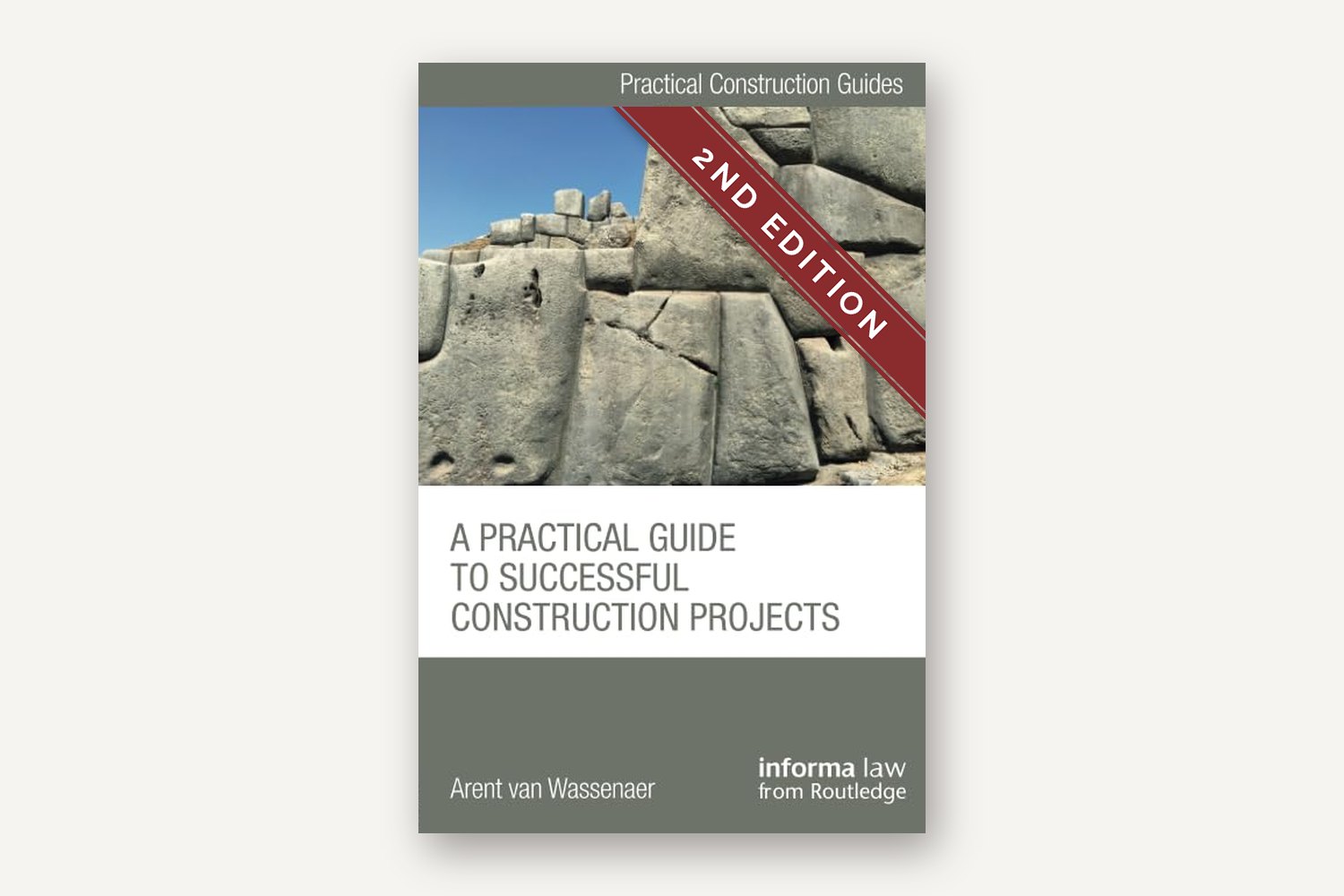
In 2017 Routledge published A Practical Guide to Successful Construction Projects. Ten years on, I have signed for a second edition, to be delivered next summer. My first instinct was to treat it as a writing job. My second, better instinct was to treat it as what it is: a construction project, of the awkward kind that starts with an existing structure.
An inherited baseline
Anyone who has worked on a refurbishment knows the problem. The drawings are not quite what was built. In my case there was no master file of the book as published: the publisher's editors had worked on the text after I submitted it, and the version of record had to be recovered from the eBook. Before anything new could be designed, the existing structure had to be surveyed.
The budget was fixed as well. The contract allows 175,000 words, about 11,000 more than the first edition. Into that space go two new chapters, one on dispute avoidance and dispute boards and one on artificial intelligence, plus ten years of new standard forms, case law and research. That is not an extension. It is a rewrite under a ceiling, where every addition has to be paid for by a cut somewhere else.
And there were stakeholders. The first edition rests on interviews with some twenty-five practitioners. In October I wrote to all of them. Many had changed jobs, countries or careers; nine e-mails bounced; two of the people I interviewed have since died. Those who answered were generous, and several of their views have shifted in ways that are more interesting than the original quotes. One contractor told me he is now more sceptical of partnering than he was in 2016. That belongs in the book too.
Running it the way I advise others to
So I did what I would tell a client to do. First the objective: one thesis that runs through the whole book, that projects succeed when disputes are prevented by design rather than resolved by procedure. Then a budget per chapter, which serves as the cost plan, and a cut list, which serves as the change register: every deletion is deliberate and recoverable.
Then the sequence. The two new chapters are written first, not because they come first in the book but because they decide what moves out of the old ones. That makes them the critical path. The chapters that only need refreshing have float and fill the gaps. There is a hard cut-off for new interview material, after which the text is written from what is in hand. And there is a checkpoint at the end of March with a fallback agreed in advance, so that any decision to shorten is taken calmly and not in July.
Finally, the relationships. Every quotation goes into a register with its source, chapter and approval status, and the people I quote see their words in context before the book goes to print. It is dispute avoidance on a small scale: no one should be surprised by what they read about themselves. Several of the new interviews will also be recorded as episodes of Building with Trust, so the podcast and the book now feed each other.
The scarcest resource is the client
Once the schedule was built, one thing stood out. The bottleneck is not the sources, the publisher or the interviewees. It is me. The plan needs roughly a hundred days of my time over eight months, alongside a practice that does not pause for a book.
That is the most familiar finding in project management, seen from the other side of the table. Owners plan their contractors' capacity in detail and their own hardly at all: the decisions, reviews and approvals that only the client can give. On many troubled projects the critical path runs straight through the client's diary. I have now blocked my writing days the way I block hearings, and that, more than any table of contents, will decide whether the manuscript arrives on time.
In short
A second edition is a refurbishment, not a new build. Survey the existing structure, fix the objective and the budget, write first the parts that change the most, agree the fallback before you need it, and treat the people you depend on as partners, not suppliers.
And plan your own time as carefully as everyone else's. The new chapter starts in January.