
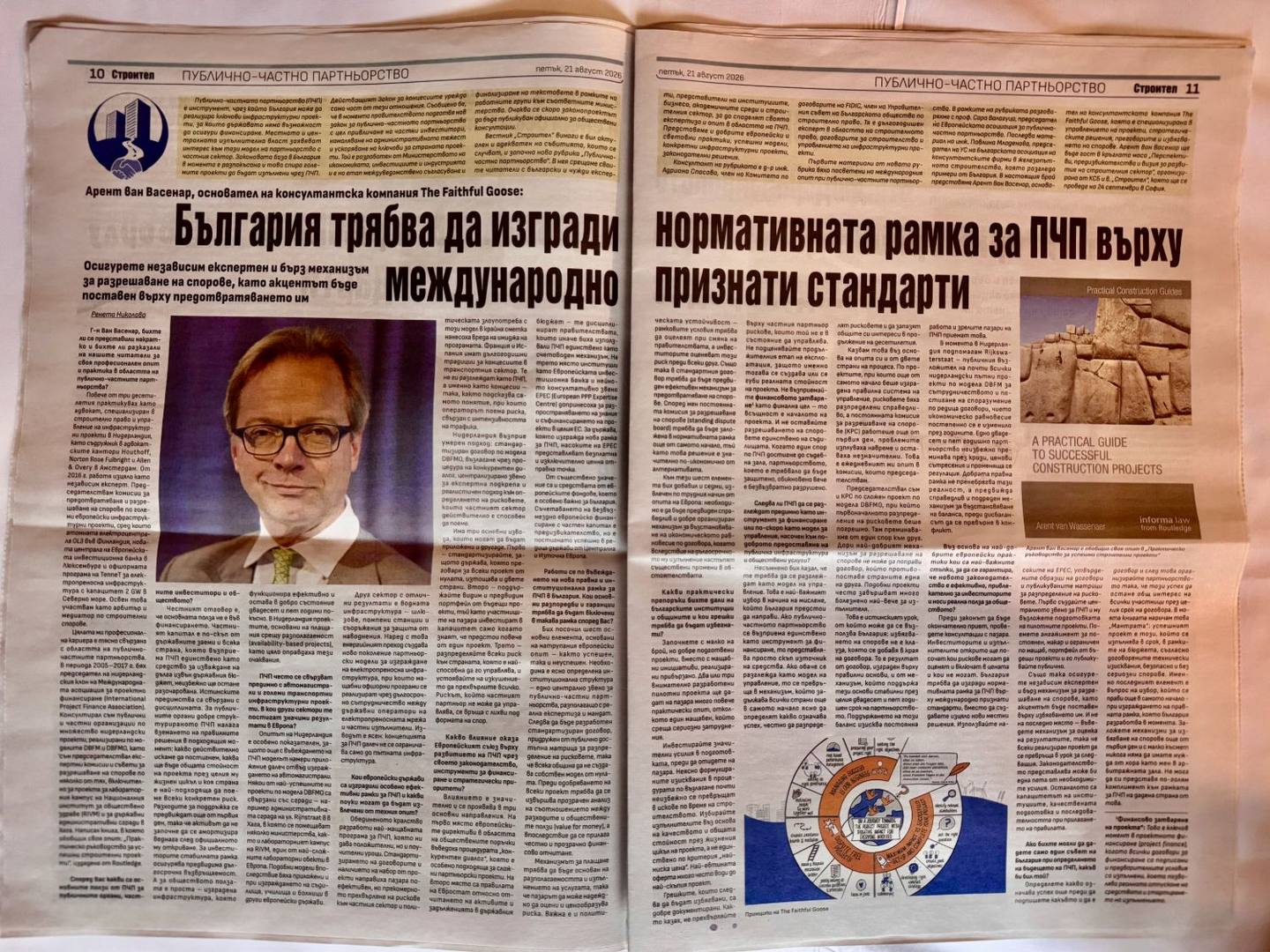
Every country that discovers public-private partnership in a year of budget deficits discovers it for the wrong reason. Private capital is more expensive than government borrowing, and a country that adopts PPP to move debt off its balance sheet will be disappointed; Eurostat will find the debt anyway. The benefit is not the money. The benefit is discipline: a PPP forces four choices at the right moment that a traditional contract allows a public authority to avoid, and usually does. What do we want, specified as an output before construction rather than during it. What will it cost over its whole life, with maintenance priced in from day one so that the asset does not quietly decay after the opening ceremony. Who can carry which risk, allocated honestly to the party able to manage it. And how do we stay aligned for twenty-five years, through payment for availability and a mechanism that keeps the partnership sound when the world changes.
The Dutch route
The Netherlands never had the largest PPP programme in Europe; it had a disciplined one. One standard DBFM(O) contract with a published risk allocation, competitive dialogue as the procurement route, a central unit pooling the expertise, and a realistic view of which risks the private side can actually carry. Some thirty projects were tendered on that basis between 2001 and 2021: motorways and tunnels for Rijkswaterstaat, locks and the Afsluitdijk, and, less well known abroad, government buildings: the Kromhout barracks, the Supreme Court, the RIVM laboratory campus, and Rijnstraat 8, a ministry building on a twenty-five-year availability contract that is still maintained under the same agreement today. The same standard contract served roads, locks and buildings, and that is what made a small programme efficient.
The Netherlands has not tendered a new DBFM since 2021. Not because the model failed: availability above 99 per cent, deductions below one per cent of contract value. The pipeline of projects large enough to justify the transaction cost dried up, and the second half of the long contracts showed a problem the first half had hidden: technical requirements frozen in year one, standards that moved in year fifteen, and a public client in a one-to-one negotiation with little leverage. Rijkswaterstaat is now recalibrating a number of contracts in which the economic equilibrium has drifted, with the cooperation and consent of the contract parties. Mature markets treat that as maintenance, not failure. A country writing its framework today can build the mechanism in from the start rather than invent it under stress in year twelve.
Seven elements, and a fifth of the work
Asked what a working framework needs, I offered seven elements: a central PPP unit with real expertise and a mandate; a standard contract with a published risk allocation matrix; a value-for-money test before approval and honest accounting afterwards; an availability-based payment mechanism the market can price; political durability, because investors read that risk before any other; a standing dispute board built into the standard contract from day one; and an equilibrium mechanism to restore the balance when circumstances change fundamentally. None of these is original. All seven are in the UNECE Standard on PPP/Concession Legal Frameworks, developed under Marc Frilet and Christopher Clement-Davies with some eighty international experts, a complete text that any UNECE member State can adapt. Article 36 puts partnering, dispute boards and mediation before arbitration; Article 32 provides for restoring the contractual equilibrium. Bulgaria does not have to start from a blank page.
But the law is a fifth of the work. Consult the market before the text is final; investors and contractors will say candidly what they can price and what they cannot. Create the central unit first and let it prepare two or three pilots before the first real project is tendered. Publish a pipeline, however modest, because market parties invest in capacity only if more than one project is coming. Award on quality and lifecycle cost, never on lowest price alone; the cheapest bid is frequently the most expensive project. And build in evaluation, so that each project teaches the next. Capacity, preparation and consistency across governments are the other four fifths.
Where the dispute board earns its keep
I was asked to speak about working models and successful examples, and I did. But the honest part of the story is the failure. I have chaired a dispute board on a complex DBFMO project where the underlying risk allocation was flawed from the start, and there we moved from one dispute to the next; even the best process could not repair a structure that set the parties against each other, and the contractor paid dearly. On the boards I chair today, where the governance was right and a standing board was engaged from day one, issues surface early and stay small. A dispute board cannot repair a flawed risk allocation. It can keep a sound one sound. That is why it belongs in the standard contract, not in the aftermath, and why the seventh element, the equilibrium mechanism, is its natural companion: the board keeps the conversation honest, the mechanism gives the conversation somewhere to go.
Two lessons from a recording made the week before Sofia, with Jan van Schoonhoven and Leon Hombergen for the podcast Bouwen met Vertrouwen, fitted the Bulgarian room precisely. Deferred maintenance becomes emergency work, and emergency work is the perfect cocktail for disputes; keep a balance sheet of your assets, even a shadow one, so that maintenance is a visible obligation and not a budget residue. And do not lock up tomorrow's budget: commit too large a share of annual spending to long contracts and the next government has no room left. That is the British lesson, and it is the one a country at the start of a programme most easily forgets.
The mantra
In my book I call it the Mantra: a successful project is delivered on time, within budget, to specification, safely, and without serious disputes. The last one is a choice, made at the very beginning, in the framework a country designs. Build dispute avoidance in from day one, and with a little luck you will never need people like me in a hearing room. I can think of no better compliment to a country's PPP framework than that.
With thanks to Reni Nikolova and Stroitel, the Bulgarian Construction Chamber, Victoria Penkova of the Bulgarian Society of Construction Law, Adriana Spassova, and my fellow panellists Serge Bodart, Volodymyr Yaremko and Sara Valaguzza. The presentation and the three factsheets of Dutch DBFM(O) projects are available on request.