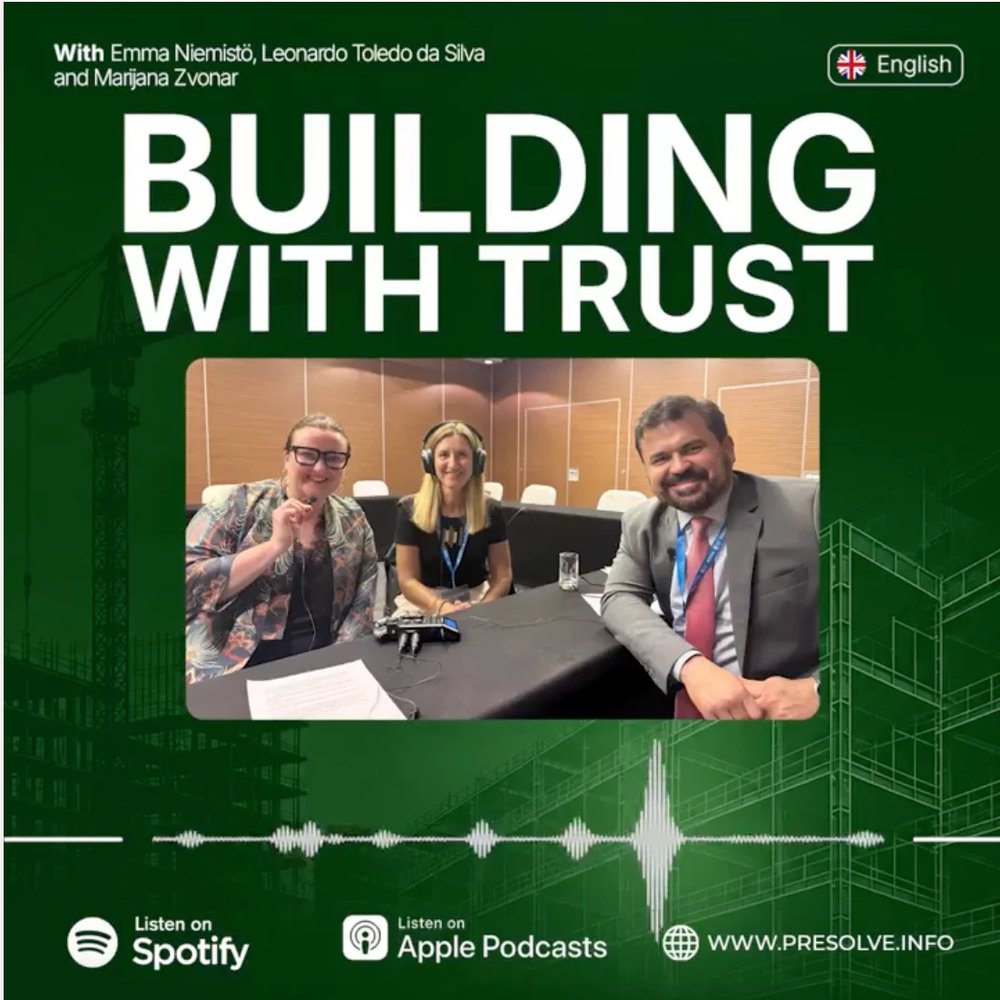
Three episodes into a podcast called Building with Trust, I had never asked anyone what the word means. So in Dubrovnik, on the evening of the ICC Croatia conference, after a long day on stage arguing about whether the contract model determines the dispute, I asked three of my co-authors on that panel paper. Marijana Zvonar is a civil engineer with Exstructa in Zagreb, born in Dubrovnik itself. Leonardo Toledo da Silva is a partner at Toledo Marchetti in São Paulo, professor at FGV, and wrote his PhD on project alliancing. Emma Niemistö is head of projects and construction at Borenius in Helsinki, and trained as a construction engineer as well.
Does trust mean the same thing in Zagreb, São Paulo and Helsinki? No, of course not. And yet it ends up in the same place.
Three words
Povjerenje, Marijana explained, has vjera inside it: faith, belief. The verb povjeriti means to entrust, to hand something of yours to someone else.
"It is something you give, not something that you calculate with."
And in a country that sits near the bottom of European surveys on trust in institutions, the courts and the public administration included, people do not expect the system to be fair. They look for a person instead.
Confiança, says Leonardo, comes from fiducia, faith again, and covers in one word what English needs three for: reliance, trustworthiness and confiding in someone. Its slang cousin is jeitinho, the little way around the rules, which Augusto Barros de Figueiredo already introduced in episode 1. Marijana supplied the Croatian relative on the spot, dogovorit ćemo se: we will agree, don't worry, we will find a solution, whatever the contract says.
Luottamus is the simplest of the three, says Emma, and the most Finnish. You earn it by performing as you promised. Finns say what they mean, sometimes bluntly, and Finnish contracts are read exactly as written. Too much wheeling and dealing makes a Finn doubt you, not trust you. Which led her to the cynic's question, and she put it herself: if everyone performs as written, do you need trust at all?
The small problem that stays hidden
The more interesting part of the conversation was not about words but about what people do with bad news.
Leonardo: a Brazilian often finds it hard to say no, or to bring a problem to the table. There is even a word, sincericida, for someone so honest it is close to suicide, and he has been called it more than once. The result on projects is that a small problem stays out of sight until it reappears, all at once, in battle mode. And Brazilians, he says, know how to battle.
Marijana recognised it immediately. There is an old Dubrovnik saying, half a joke now, that tells the young to be polite to everyone and honest with no one, a habit from centuries of a small republic surviving between bigger interests. On Croatian sites a contractor with a manpower problem tries to fix it quietly; when the engineer notices and asks, it is "a small problem, we will sort it out"; and then comes the request for an extension of time. Had he come at the start, it would have been manageable.
Emma's worst cases are the mirror image: public employers who will not even try to understand a risk that has plainly materialised, followed by a long arbitration over effects that everyone could see with the naked eye.
Two stories show what the difference is worth. Marijana's: a contractor she had worked with before now calls her the moment he has a problem, and asks whether the employer really needs that completion date, because he knows she will not use it against him. Leonardo's: a contractor in an early contractor involvement contract who would not, as he put it, show the kitchen of the restaurant, and would only present ideas once they were finished. It did not get the construction contract. Not only for that reason, perhaps. But not trusting that the other side will trust you is its own kind of risk.
The scaffolding
So who was right, the faith of povjerenje or the cold reliance of luottamus? Both, and neither. Emma does not think you need a formal concept of trust for a project to work. What you need are people, on site and in the big room and the ECI workshops, who create and enforce trust between themselves. It is not automatic, not even in Finland, where alliances have seen trust compromised too. You start before the contract and you rebuild it at every stage, above all when the going gets hard.
Leonardo, from his research, made the point I want to carry away:
"The real trust is built within every project, like internally."
You can inherit some from a previous job. But most of it is made on this one, and that is where the contract comes back in. Not as the source of trust, but as its scaffolding: the formal mechanisms that tell people this matters, and hold the structure up while the trust is still being built.
In short, trust is not imported with the language, the culture or the contract form. It is built, project by project, by the people on it. The contract only puts up the scaffolding. Climbing it is still up to us!