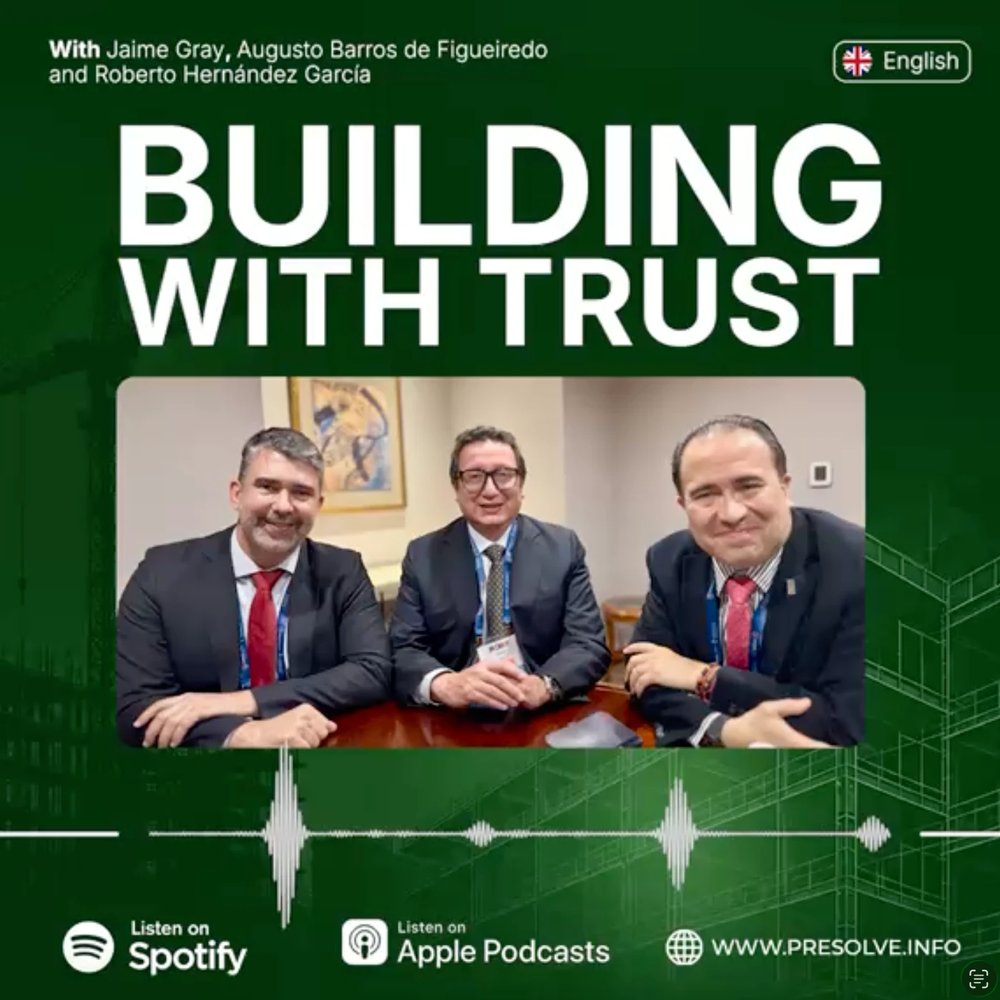
The dispute board is a dispute institution whose whole purpose is to prevent disputes. Can that work in a region where trust does not come easily? That was the puzzle I brought to Lima, to the DRBF's Latin American conference, and put to three friends: Jaime Gray of NPG Abogados, former president of the DRBF's Region 4; Augusto Barros de Figueiredo of Rio de Janeiro, one of the people who brought dispute boards to the 2016 Olympic Games; and Roberto Hernández García of COMAD in Mexico City, with whom I am preparing a masterclass in Panama next year. Three countries, three speeds, and a conversation among friends in which I tried, and largely failed, to be the sceptic.
The unfinished sentence
Almost ten years ago to the day, at the Hotel Unique in São Paulo, Augusto told me about Rio: fifty-six contracts under a dispute board system, forty-two notices, zero referrals. My book went to press with the story unfinished. In Lima I asked him to finish it. He left the organising committee two months after our conversation, but stayed in touch with the colleagues who wrapped up the programme for another year and a half, and the answer is the one I had hoped for: no disputes after the Games either. Part of that was the boards; part, he says candidly, was the structure of the Games themselves, because no contractor wanted to be the one who did not deliver. Brazil then went through a political and economic crisis that hid the good side of the legacy from its own public. But the country has kept advancing, "not as quick as Peru, but at the right pace".
The leap of faith
Jaime first heard the words dispute board at an IBA conference in Cancún in 2001, was convinced in theory, and was equally convinced he would never be able to use one in his region: the general controllership's view of anything that looked like managerial discretion made it unthinkable. What changed his mind was a highway in Honduras, the CA-5, financed by the Millennium Challenge Account under FIDIC conditions, where he sat as sole board member. The parties changed the way they talked to each other; they read the contract together; they asked about each other's interests. "It was not me," he says. "It was the tool." Peru's procurement agency heard about Honduras, exchanged views, and, in Roberto's words, "gave a leap of faith": a law allowing dispute boards on public works. Peru is now the most advanced dispute board jurisdiction in the region. Jaime's explanation is characteristically Peruvian: "We are very daring. Let's try this, why not?"
Mexico, Roberto admits, is not the example to cite. He and Jaime were trained together and had their first experience on the same Honduran road, but at home the fight to include boards in contracts continues. His point is a regional one: the contagion from one country to the next has been good, and the countries that are not yet there should learn from the success stories and from the mistakes.
The platypus
Why is the dispute board so often misunderstood as a small arbitration? Jaime's answer is the platypus. It has a beak and lays eggs, and yet it is not a duck; it is a mammal. The board has similarities with arbitration, but only during the formal process when a submission is made; it has similarities with mediation and negotiation too; and it is none of them. Roberto adds what the metaphor misses: the board member lives with the project, with the employer and with the contractor, rather than watching from a height. That is a very different experience from arbitration, and a different profession.
What the contractor gets for the money
I pushed back: from the outside a board looks like another layer of lawyers and another fee. Augusto's answer is time and cash. Brazil's leading case, on Line 4 of the São Paulo metro, spent years in the courts on the question whether a board's decision was enforceable at all; the decision on the merits came only seven years later. A board gives a decision in real time and protects the cash flow. Roberto's answer is about a generation of project managers: the dictatorial style that "always won" is giving way, slowly, to the recognition that a project is a business, that you will meet the other party again, and that enemies are expensive.
Confianza, and jeitinho
Trust, confianza in Spanish and confiança in Portuguese, was the word of the conference. The question is not whether the parties should trust each other; it is how a board builds trust in a room where nobody is allowed to. Roberto's image is the equaliser, or the therapist: the third party paid by both sides who can see the gap in the contract, the planning that was wrong, the employer who is too authoritarian or the contractor who is too loose, and help the parties see what they cannot see about themselves. Jaime's is simpler: convince each party that it is not alone, that it is in the same boat, and that "I am always right and you are always wrong" is a stupid thing to say to someone you need to finish your project.
And then jeitinho, the Brazilian word I had been told I would not find anywhere else. Augusto corrects me: it is not about trust at all but about finding a way out of a tight spot with the resources you have, and it can be good or bad depending on whose hands it is in. Roberto draws the line for board members: good jeitinho is creativity in reaching the goal by other than formal means; bad jeitinho goes around the law or the ethics, and a board has the duty to lead the parties towards the first and away from the second.
When a decision is the avoidance
The most useful exchange of the half hour was about decisions. In Peru, Jaime says, a party will sometimes tell the board: I agree with you, but I need a formal written decision, because the auditors will ask. The decision gives the official the authority to pay or to grant time. Augusto calls it the lack of empowerment of the people closest to the project; Roberto calls it compulsory guidance, and human nature. And Augusto's friend gave him the line of the episode: a quick no is worth as much as a yes. A timely decision is not the failure of avoidance; it is often the act of avoidance itself.
The secret
Roberto: respect, for the contract, for the balance of the deal and for the other party. Jaime: do not confuse claims with disputes, respect the contract, communicate openly, and use common sense. Augusto: all of that, and never forget that disputes are mostly about people.
Building with Trust is the English edition of Bouwen met Vertrouwen, the podcast of Presolve, the Dutch centre of expertise for dispute-free construction. Listen on Spotify or Apple Podcasts. The conversation will also feed the case-study chapters of the second edition of A Practical Guide to Successful Construction Projects (Routledge, 2027). Episode 2 is recorded in Copenhagen on 4 October with members of the IBA International Construction Projects Committee, on whether the contract model determines the dispute.